From Physics to Supply Chain Leadership: An Interview with Miles Vinikow, MTM Class of 2019
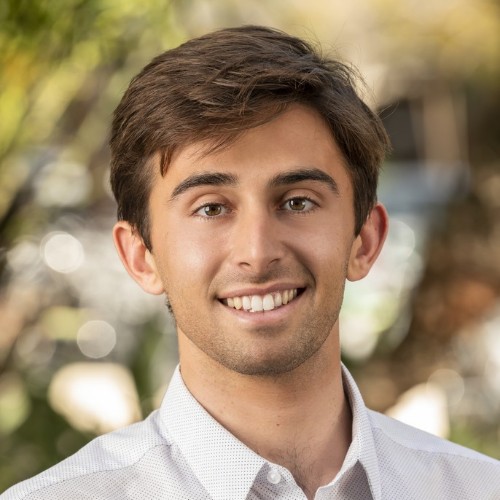
Q: Tell us about your background prior to joining MTM and what motivated your transition.
Prior to MTM, I had more of a scientific focus. In my undergraduate education, I studied physics at UCSB, worked in research and clinical trials for A1C medical devices, and spent time in hospitality and entertainment. While I enjoyed combining technical settings with direct human interaction, I realized a traditional research path wasn't for me.
Seeking to broaden my horizons, I found that MTM was a great fit. It offered academic rigor along with practical avenues like the New Venture Competition and teaching opportunities that allowed me to expand my skillset through multiple lenses.
Q: Looking back at your time in the program, what were some of the key highlights?
The cohort-based model was a major highlight. Constantly collaborating in small teams mirrored how work is conducted in professional environments.
The New Venture Competition (NVC) was another milestone. My team's project focused on reselling excess deadstock fabric to small designers. Pitching, testing product-market fit, and interacting with the local entrepreneurship community forced me out of my comfort zone and taught me how to effectively advocate for ideas.
Q: What did you focus on for your MTM field project?
My field project was with Teledyne FLIR (formerly FLIR Systems). We worked closely with a UCSB MTM alum on solving real-world business challenges centered on knowledge transfer and employee retention. It was invaluable hands-on experience addressing organizational dynamics for a major local employer.
Q: How did you transition into your career at Deckers Brands, and what has your trajectory looked like since?
Through our advisor in NVC, Dave Adornetto, I was connected with the leadership team at Deckers. What started as a lunch conversation about our business plan turned into a job offer as an analyst in the finance organization. The technical, data-programming, and research skills I developed during my time in MTM were instrumental in helping me succeed early on.
From finance, I moved into the Digital & Data organization to refine my data science and engineering skills, and then transitioned into Supply Chain five years ago. Starting in a chief-of-staff role for our CSCO, my responsibilities expanded into managing strategy, business planning, analytics, continuous improvement, and strategic materials procurement—eventually growing into my present role as Senior Director of Supply Chain Excellence.
Q: What advice do you have for current or prospective MTM students on networking and getting the most out of their experience?
You truly get out what you put in. Take full advantage of the resources available to you—whether that's tapping into faculty expertise, getting involved in supplemental programs like teaching or research assistantships, or leveraging the broader community network.
When it comes to networking, leave a rigid, scripted agenda at the door. Focus on building authentic connections rather than searching for an immediate outcome. Be genuinely curious —that makes all the difference.
This also applies to your job search. I applied to an immense amount of roles and was overwhelmingly rejected from the majority of them through automated emails. I found that the most effective approach was to connect with people and just learn about what's out there. The advice that we received in MTM at the time was to try and find what could be your future self–people who are doing what you want to be doing in the future–and explore whether that hypothesis resonates with you. So picking up the phone, being curious, and knocking on doors, that was more effective for me in my job search than the cold application on LinkedIn.
Q: How do you view the role of AI in today's workforce, and how did your technical training prepare you to adopt it?
During MTM, my research assistantship examined team dynamics in hybrid human-AI environments. Combined with my foundational background in physics—thinking from first principles, establishing initial conditions, and finding optimization pathways—I was well-equipped to integrate AI into day-to-day operations.
I see two primary archetypes driving value with AI: the generalist orchestrator and the specialist. Orchestrators bring domain breadth to connect cross-functional capabilities and act as force multipliers. Specialists use AI as an accelerant to dig deep into specific verticals and drive innovation.
Ultimately, AI is another tool where quality input yields quality output. Thoughtful system architecture, precise prompting, and first-principles thinking are essential for unlocking its full potential.
To learn more about MTM, visit tmp.ucsb.edu/mtm.