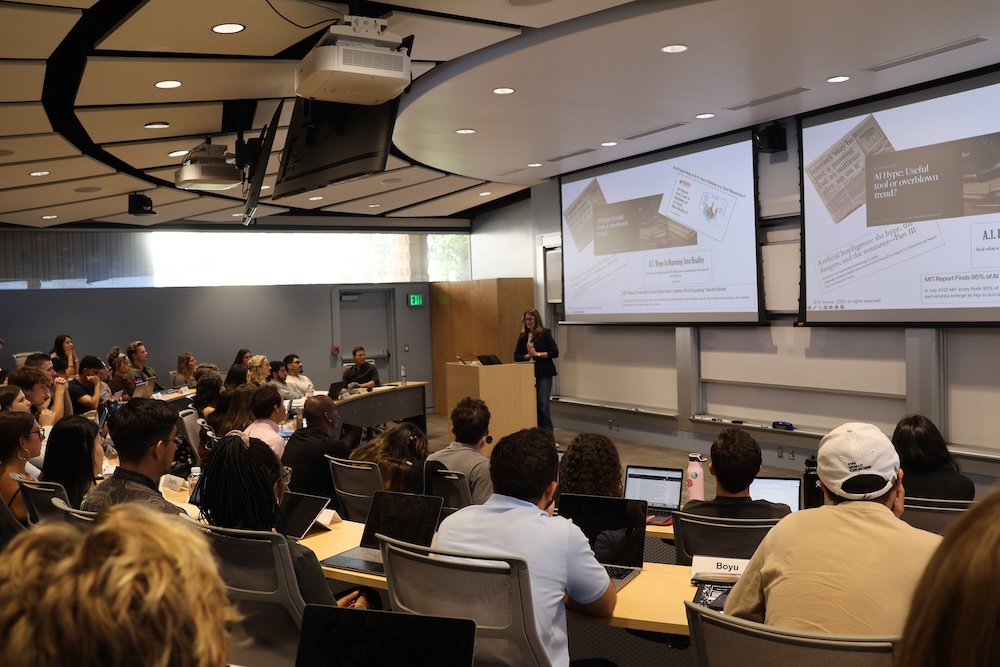
Students in UCSB’s Master of Technology Management program celebrated the start of Fall Quarter 2026 with a brand-new opportunity: a three-day AI intensive that gives students the hands-on skills to work effectively with LLM and Agentic Engineering tools.
Building off of the program’s instruction on managing technology-driven organizations and teams, the Intensive is designed to incorporate experiential learning with AI from the very first days of the program. As AI continues to evolve and shape the strategy of business, MTM students are able to get ahead of the curve by incorporating these skills into their business education immediately and have that knowledge at the core of their studies.
Dr. Brewer presents in front of the MTM Class of 2027 on the media "hype" surrounding AI tools.
The 2026-2027 school year will feature a different AI Intensive workshop during Week 1 of each quarter, each focusing on a different skillset and applications. The fall intensive focuses on prototype building, winter focuses on data scraping and analysis, and spring focuses on AI agents for workflow automation and process improvement. Each session combines demonstrations, guided exercises, and sustained building time, culminating in a presentation of a fully functional concept. Students will then apply the skills developed in each intensive to their MTM courses throughout the subsequent term, with the goal of becoming a more capable builder and a more informed leader of work involving AI.
The Fall Quarter AI intensive is taught by Melanie Bennett Brewer, Ph.D., who is currently the Research and Strategy Director for IQVIA, a leading global provider of clinical research services, commercial insights, and healthcare intelligence to the life sciences and healthcare industries. For IQVIA, Dr. Brewer created an AI-native design system that empowers fully agentic design, while adhering to legacy design system visual identity to increase delivery speed, improve accessibility, and ensure high performance with life sciences agents. Using AI-native processes to create an alpha application with multiple services, Dr. Brewer reduced a pharmaceutical regulatory affairs workflow from 22 minutes to 22 seconds, a 98.5% efficiency gain.
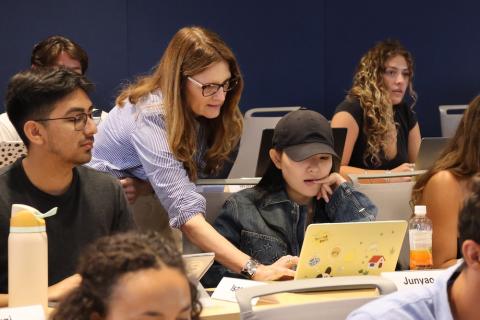
Dr. Melanie Brewer assists an MTM student with the class demonstration.
Students in the workshop engaged in a variety of demonstrations of different AI tools: Cursor, for AI coding, LLMs such as Grok for project brainstorming, expanding prototype capabilities with API keys, publishing code with GitHub and Vercel, and more. The Fall Quarter workshop culminated in students demonstrating their functional concepts of apps they designed; examples of projects include an app that scans your gym environment to create personalized workout routines, an app that allows users to input the ingredients they already have and receive a list of recipes they’re able to try, an automated scheduler for optimized houseplant watering times, and a restaurant database with aggregated reviews and menu suggestions for travelers in brand new cities.
Awards were presented to the students for their prototypes: Best Design, Most Marketable Product, and Best Use of Generative AI.

MTM student Yan Reis presents his prototype, a luxury goods sales inventory tracker, in front of the class. Reis was awarded "Best Design."

MTM student Bence Hevér smiles after receiving feedback on his project from Department of Technology Management Chair Dr. Paul Leonardi (left).
“In companies today, leaders now expect you to be able to show them something. Those fluent in how to use agentic engineering tools do not need to rely on a technical person or a team to do so,” explains Erin Nerstad, Executive Director of the MTM Program. “With their new skillsets, MTM students will be able to bring an idea to life quickly and effectively through a prototyping process that goes beyond vibe coding. By leveraging the power of agentic engineering, students can build product prototypes that are designed with intention and subject to a rigorous process that includes research, wireframing, iteration, and safety and security protocols. Our students can now collaborate effectively with reasoning models and coders–essentially giving them a very smart, high-powered team at their fingertips.”
Students–many of whom had never used Generative AI software before–noted the remarkable speed at which they were able to learn the tools in the intensive.
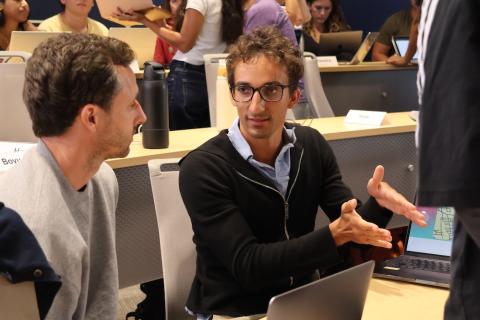
MTM student Giorgio Braccia explains his prototype to a member of his cohort.
“We started the AI intensive talking about vibe coding and agentic coding, and moving into prototype building with an application called Cursor that I had never used at all. The crazy thing was, is it only took us about 30 minutes to really get into the program, and how intuitive and in-depth it was to start our prototype building,” says Mark Lessley, a veteran of the film industry who is now bridging his media post-production experience into project management. “It was amazing how in 3 days we went from building it, testing it, to demoing it, and talking with the cohort and seeing some of the ideas that they also had. . .just based on the amount of time we had, and what we were able to turn out, it was super impressive.”
“For me, most interesting part of the intensive was learning how easy it is to actually make a prototype of something that can become workable,” remarked Sarah Strasberg, who entered the MTM program after recently graduating with her degree in Global Studies from UCSB. “Using AI to generate code made me see how accessible this could be, even for someone with a humanities background like me.”
“What’s exciting about this technology is that people from all backgrounds can create a digital product and bring their ideas to life. Prototypes then serve as a communication artifact, enabling you to tell a compelling story about your design thinking and problem solving,” says Dr. Nerstad. “What is also very exciting about this AI Intensive is that it creates a supportive learning environment that allows students to experiment with support from experts–Dr. Brewer, Prof. Leonardi, our Ph.D. student teaching assistants–and quickly iterate on these skills. It was amazing to see what the students were able to accomplish in just three days, and I’m so excited to see what else they build from here!”
The MTM program would like to extend thanks to Cursor for supporting this workshop by providing MTM students access to their platform.
Get a closer look at the MTM Curriculum at https://tmp.ucsb.edu/academics/master-technology-management/curriculum
Learn more about UCSB’s Master of Technology Management program at https://tmp.ucsb.edu/academics/master-technology-management