The ProFoldBio team at the 2024 New Venture Competition finals. From left: Samuel Lobo, Devon Callan, Erica Keane Rivera, Ventura Rivera, Austin Dubose.
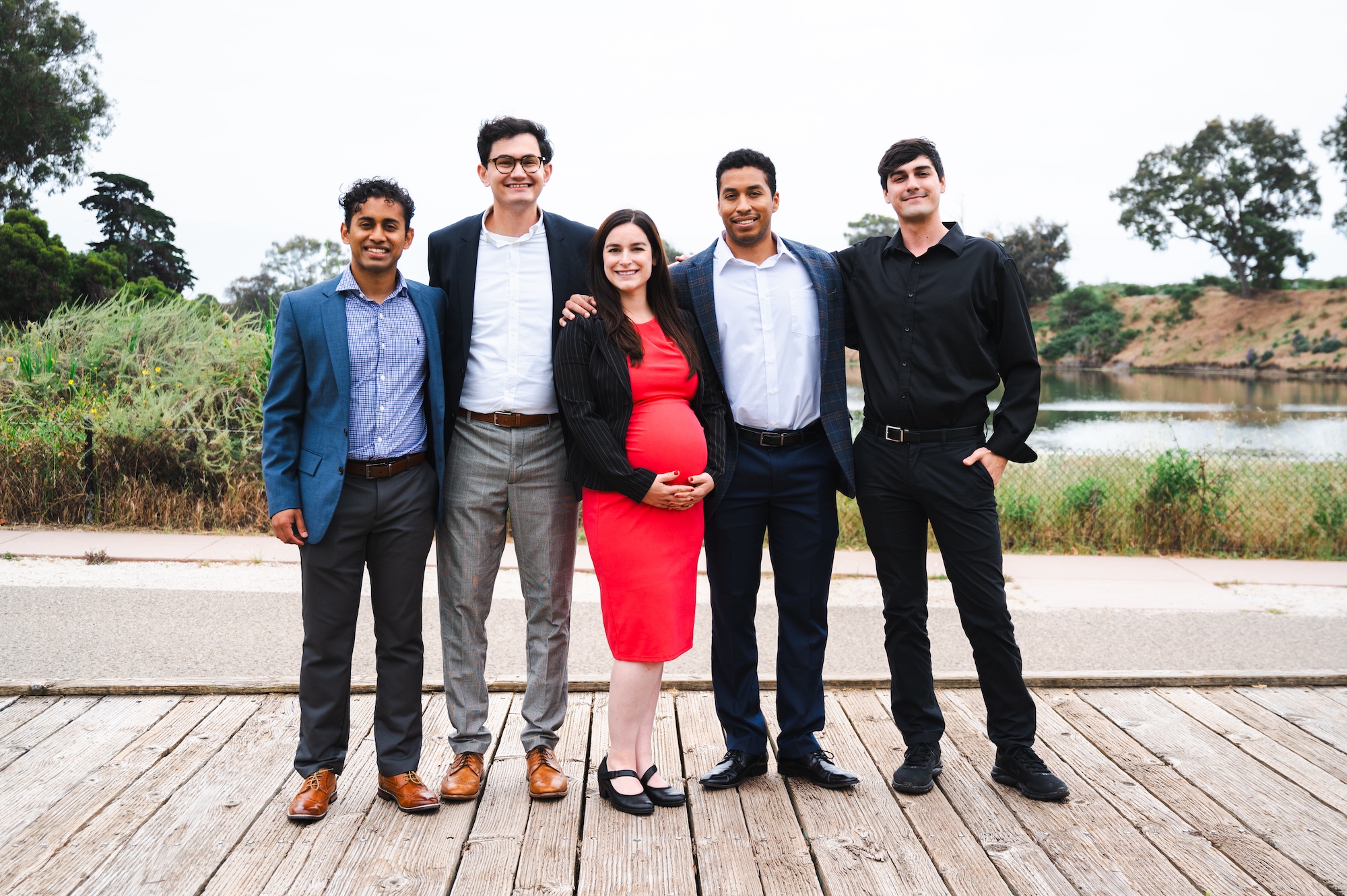
The ProFoldBio team at the 2024 New Venture Competition finals. From left: Samuel Lobo, Devon Callan, Erica Keane Rivera, Ventura Rivera, Austin Dubose.
ProFoldBio, a startup formed through UC Santa Barbara’s New Venture Program, is launching software to accelerate the discovery process for therapies aimed at treating Alzheimer’s and other diseases. The virtual platform, developed by a team of UCSB engineering and molecular-biology graduate students, allows users to design, screen and test new antibodies, thus reducing the time and the cost of identifying promising drug candidates and moving them into clinical trials.
Along with making the software available to other researchers in industry and academia, the team members at ProFoldBio — one of nearly seventy startups to have emerged from UCSB’s New Venture Program — are using the software themselves to seek out potential therapeutics for Alzheimer’s disease.
Samuel Lobo, a recent PhD graduate in chemical engineering, says that the software helps to overcome several issues that arise when studying diseases, such as Alzheimer’s, in which amyloid proteins play a role. Testing potential therapies that act on amyloid proteins typically requires the proteins to be extracted from human tissue. But the tissue can be challenging to obtain and often provides insufficient amyloid protein, “making it really hard to test potential drugs,” says Lobo, who is also the chief scientific officer for ProFoldBio.
“Treating amyloid diseases has been arguably one of the most challenging problems in modern medicine, with decades of research and pharmaceutical efforts” resulting in remarkably few therapeutics, says M. Scott Shell, a UCSB professor of chemical engineering and Lobo’s advisor. “What’s incredibly exciting here is that modern computational-modeling tools, advances in machine learning, and systematic engineering strategies now make it possible to approach these systems in a predictive way that drives molecular-scale characterization and discovery.”
The ProFoldBio team intends for their software to broaden access to such discovery methods. “These sorts of computational workflows and infrastructures are typically available only to larger biotech companies,” says Erica Keane Rivera, a molecular biology PhD student and the company’s CEO. The software could be a boon for smaller companies and independent researchers, as the team has brought together generative AI tools in a publicly available platform that allows researchers whose strengths lie in experimentation, rather than programming, to quickly begin designing.“There's a pretty low barrier to entry for using our platform,” Keane Rivera says.
The ProFoldBio team formed in 2023 via UCSB Department of Technology Management’s eight-month New Venture Program, which brings together undergraduate and graduate students in any discipline to develop and refine business ideas, with the guidance of faculty and industry mentors. The program ends in spring with the annual New Venture Competition (NVC), when finalist teams vie for up to $40,000 in cash, startup grants, and support. Inspired by their shared interest in amyloid diseases. Lobo, Keane Rivera, chemical engineering PhD student Devon Callan, and UC Berkeley chemical engineering alum Ventura Rivera joined forces to develop their software platform.
The team has received recognition from multiple sources. Initially called DeNovo Therapeutics, it earned second place and a $7,500 prize at the 2024 NVC. Since then, the company has been invited to UC Berkeley SkyDeck’s Pad-13 incubator program. In 2025, their hydrophobic interaction chromatography model took third place in the Ginkgo Bioworks Antibody Development Competition, based on the platform’s ability to assess a drug’s hydrophobicity — a measure indicating whether the drug would be both suitable for manufacturing and able to reach its target effectively.
This article was adapted from a piece originally written by Cameron Walker for the College of Engineering. For the full story, visit the original article:
🔗 UCSB Startup Builds Software to Speed Drug Discovery